Quadratic Programs and QCQPs in GTSAM
Author: Frank Dellaert and Yetong Zhang
Quadratic programming is one of the quiet workhorses behind modern robot motion. In legged robot locomotion, QPs show up in contact-force allocation, whole-body control, and model-predictive control loops that have to respect friction, torque, and unilateral-contact constraints. In quadrotor flight, small QPs appear whenever a desired thrust vector has to be mapped onto bounded rotor speeds. These are everyday constrained optimization problems that many GTSAM users already solve somewhere else in their stack.
GTSAM now has first-class building blocks for QP and QCQP modeling in the constrained module. The new pieces let you express quadratic objectives, linear constraints, and quadratic constraints over direct Vector and Matrix entries in Values, while still living inside GTSAM’s factor-graph-flavored ecosystem. There is also LP support, which is useful and closely related, but less central to the typical GTSAM user. This post therefore focuses on QP and QCQP.
QP: Quadratic objectives with linear constraints
A QP optimizes a quadratic objective subject to linear equalities or inequalities. In GTSAM terms, that means you can combine a quadratic cost, such as one coming from a HessianFactor or QpCost, with constraints like A x = b, A x <= b, or A x >= b. Geometrically, the optimizer is looking for the lowest point of a bowl after slicing it by planes and half-spaces. The active constraints are the boundaries that actually determine the final solution.
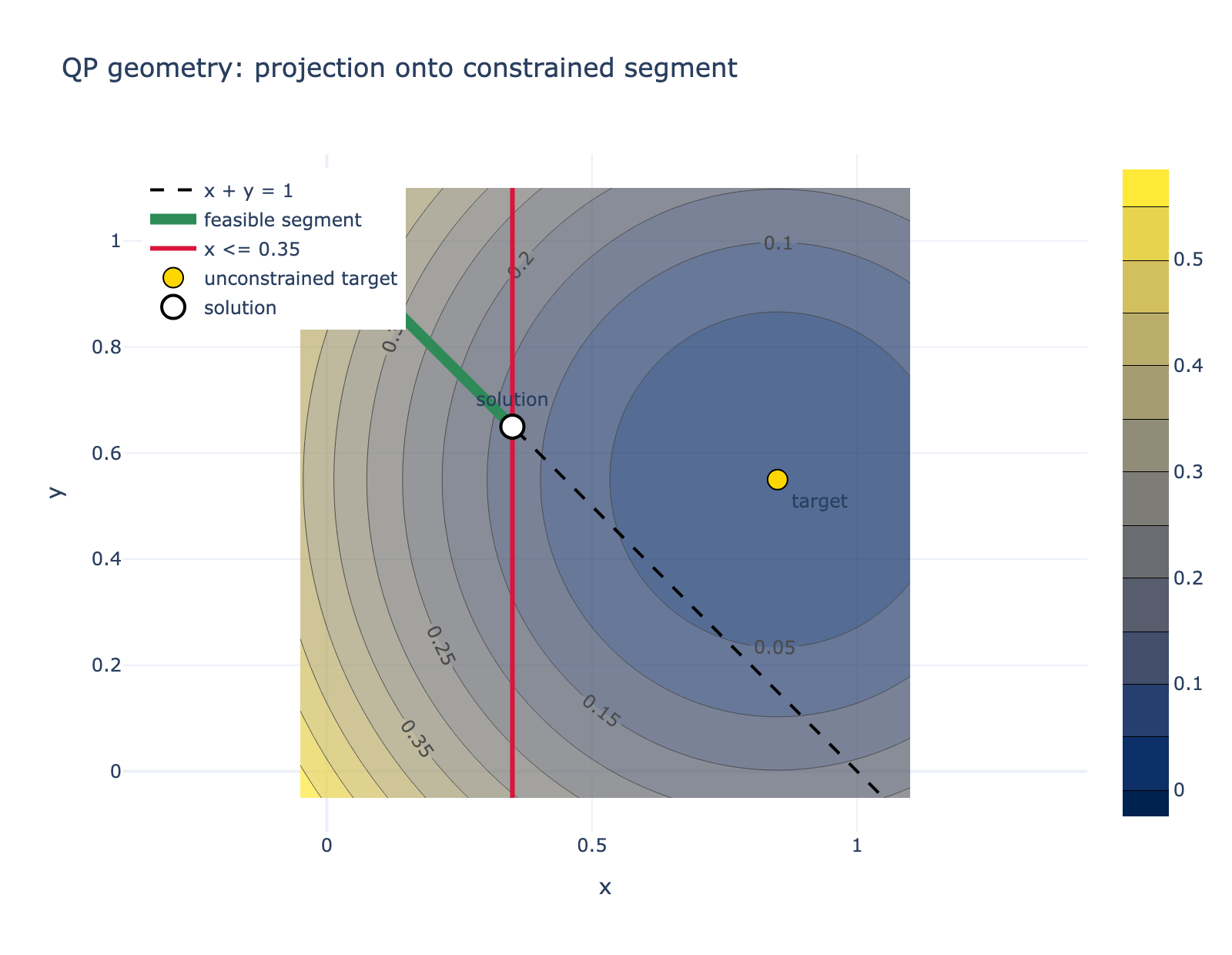
The two-dimensional QP example above makes these active constraints visible. The yellow point is the unconstrained target, the dashed line is an equality constraint, and the green segment is the part of that line that survives the inequalities. The optimizer yields the best target-compatible point that still satisfies all constraints. This same model describes many robotics QPs, even when the variables are contact forces, accelerations, or actuator commands rather than two plotted coordinates.

The quadrotor allocation example above shows why small QPs matter in real-time systems. Given a desired thrust and body torque, the allocation matrix maps four normalized rotor thrusts into a wrench, while box constraints keep each rotor inside its physical range. The unconstrained request would push one rotor beyond its limit, so the constrained solution saturates that rotor and distributes the remaining effort across the others. This is a tiny, fixed-structure problem where warm starts and solver overhead matter.
In terms of solves, both LP and QP problems have a sparse active-set solver, which is the natural starting point for chains, grids, and SLAM-like structures, where sparsity matters. QP also has a dense active-set path for tiny warm-started fixed-structure problems, such as the control-allocation QP above. There dense linear algebra beats graph setup costs. Because QPs are constrained optimization problems, they can also be handed to any constrained optimizer, such as the augmented Lagrangian optimizer.
QCQP: Quadratic constraints
A QCQP keeps the quadratic objective but allows the constraints themselves to be quadratic. Instead of only carving a bowl with lines or planes, a QCQP can impose boundaries such as ellipses, spheres, norm bounds, and other scalar quadratic relations. That small change is important because many robotics constraints are naturally quadratic, e.g., “being on the $SO(3)$ manifold” can be expressed as a set of quadratic constraints.

The QCQP geometry example above shows how much changes when constraints can curve. The target lies outside the feasible region, but the feasible region is no longer a polygonal slice of the plane. One quadratic constraint creates the circular boundary, while another bounds the squared vertical coordinate. The solution sits where those two active quadratic constraints meet. This is still an optimization problem over familiar Values, but the feasible set has become rich enough to express a much broader family of robotics problems.
In particular, QCQP is a common language for convex relaxation and certifiable state estimation. Many estimation problems that start as non-convex geometry can be lifted, relaxed, or bounded through quadratic objectives and quadratic constraints, and those formulations are often the bridge to certificates of global optimality. That is the exciting part we are only hinting at today: future posts will go deeper into how these ideas connect to certifiable estimators in GTSAM. Stay tuned !
Takeaway
The takeaway is that GTSAM’s constrained module now reaches beyond nonlinear least squares into optimization models robotics users already rely on. QP gives you a standard way to model constrained quadratic objectives, QCQP adds quadratic feasible sets, and the docs and notebooks (see below) provide runnable examples without requiring a separate optimization package just to get started. LP, QP, and QCQP open a path toward richer constrained estimation, control, and certifiable inference inside GTSAM.
Additional Reading
The practical entry points are the notebooks and docs rather than a long API tour here. The QpProblem docs describe the core QP model, and the runnable QP example notebook shows both a two-dimensional geometry example and a quadrotor allocation example. The corresponding QcqpProblem docs and QCQP example notebook cover quadratic constraints. If you want the linear-programming sibling, the LP example notebook is the right place to start.
Disclosure: AI was used to help draft this post and prepare the figures.